IS QUALITY ASSURANCE NECESSARY?
- Obiefuna Obidike
- Apr 19, 2022
- 3 min read


Some may argue with me that quality assurance is not necessary because I " have an elaborate plan" set out. However, I hope to help you understand better what quality assurance can bring to the table, and at the end of this post, you be the judge as to if it is necessary or not.
For this project, quality assurance was actually carried out at different stages, as different stages of the product require different instruments and environments to operate.
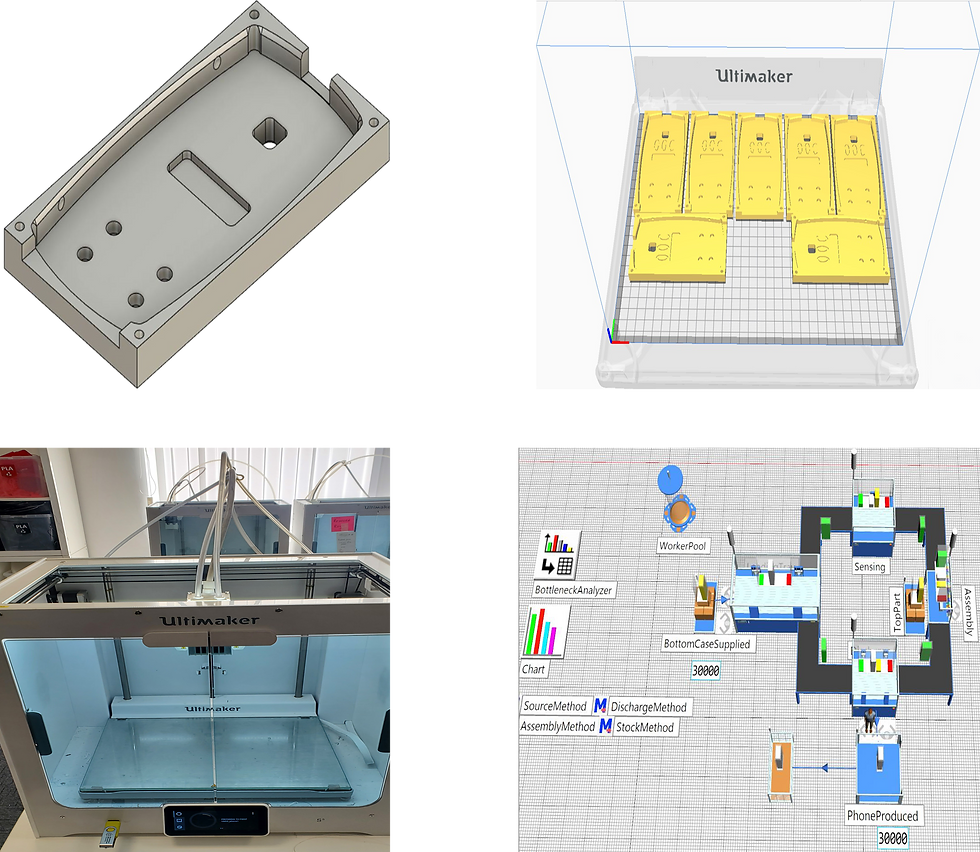
At the Design Stage, there were a couple of boxes that I needed to tick off to ensure that the 3D design of the model is made with the right setup and dimensions to ensure the quality of prints (from first test print to mass printing for supply). first, I had to ensure that the units were in line with the units of the 2D design given by Phone-R-Us in this case I had to ensure that the distance measurement unit is set to mm.

With that sorted out, I went further the ensure that my design would be contained in the least available resource I have when it is ready to be 3D printed. in my case, the Ultimaker 3 is the least available resource because it has a build volume of 230mm x190mm x 200mm. I designed and modelled a glass box with that dimension before designing the phone case model.
I have to also point out that the positioning of the engraved(cut-extrusion) marker "OOC" is crucial so that it would not interfere with the quality control proximity (height difference) sensor used by the Phone-R-Us production line in evaluating if there was a design error.
As you can see below, positions "1" and "2" are necessary for the sensor and should be clear always.
clearly, the phone case with the marker "MADE BY OBIEFUNA OBIDIKE" faults this.


But having printed the models and in order not to waste already printed material and increase the cost of production (which by all means is the ideal goal of any producer), I tricked the proximity sensor into passing the phone casing by using a thin sheet of a label just on position "2".

I ran the next assessment during the printing phase, before slicing the 3D model (which was saved from fusion 360 as an STL file ) on Cura and putting it in a Pendrive to instruct and control the printer's printing, I had to ensure that loaded materials in my case, PLA and PVA that were to come out from the print cores of the printer were coming out fine and all impurities were taken out.

Because of my belief that quality assessment encompasses quality time (efficient use of time), I had to ensure that the right print cores which I would use to slice my 3D model were inserted into the printer. For my printing, I made use of cores AA 0.4 for PLA (Main printing material) and BB 0.8 for PVA (Support printing material).

Furthermore, during the slicing process in Cura, I ensured that I enabled the support interface to allow ease of support removal and non-damage to the main print during removal.

With all these activities done, I went further to test a piece of my print on Phone-R-Us production line and coupled it with the other piece of Phone-R-Us to get the complete phone casing and it ran and coupled seamlessly.
Now, my esteemed readers, I'd love to know your thought on the Quality Assurance Processes undertaken.
Do you think having undergone all those quality assurance processes was necessary? or should I have taken it for a test with Phone-R-Us resources straight away?


Comments