Mass Printing Process Simulation: Process Visual Aid One
- Obiefuna Obidike
- Apr 21, 2022
- 5 min read


With quality assurance done, it was time to simulate the event of mass printing the Bottom phone casing which I will be supplying, and the production of the phone in on Phone-R-Us production plants. First I would have to identify the known knowns.
utilizing the known knowns and known unknowns table by Donald Rumsfeld. I will be able to point out the variables I know from the variables that are unknown.

Known Knowns
Bearing in mind that I had to make 30,000 phone casings and with Modeling, Slicing and Printing done, I now had the ability to pinpoint and decide some variables.
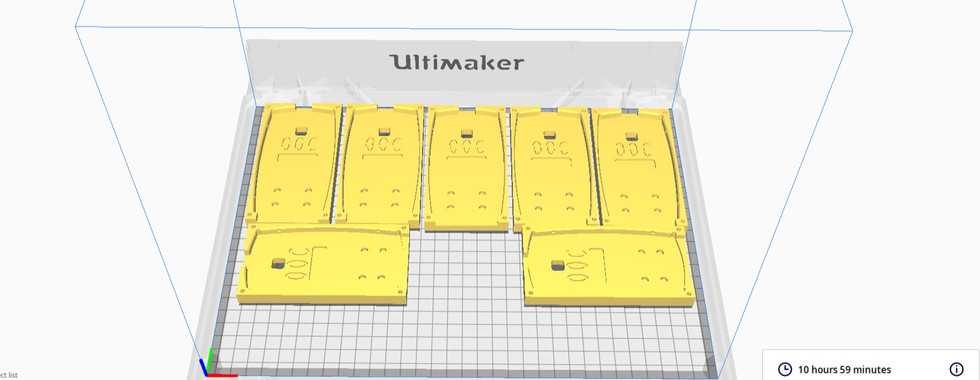
Using cura I was able to simulate just how many prints I can get using either an Ultimaker 3 extended or an Ultimaker s5, how long it will take me, and just how much it will cost. Although the time to post-print was not included, I was able to identify a major variable to assist me in simulating the mass printing of Phone-R-Us bottom phone case for supply.
With an infill of 10% on cura, I was able to get 7 prints for 10hours 59 minutes at £6.05 and 6 prints for 9 hours 25 minutes at £5.19 Ultimaker s5 and on the Ultimaker 3 extended 4 Prints for 10 hours 40 minutes at £3.83 and also 3 prints for 7hours 56 minutes at £2.88.



Unknown Knowns
Armed with printing times for various arrangements and the two Ultimaker printers. I was left to predict times for my post-printing and changing of printer filament case. I came to understand that this process is actually man-dependent and timings can vary. with that I came up with adding an extra 3 minutes per print to the printing times I got from cura to accommodate this. this may be way overboard but in my opinion, it is best to be over budget than under budget. Utilizing Microsoft Excel, I created a table to account for the additional times.

Mass Printing Process Simulation
Having gotten various times for 2 sets of printers based on their arrangement, I had gotten the variable needed to help me in simulating an estimated number of days as to which mass printing will be completed. for this I made use of the Siemens Tecnomatix Plant simulation software, Honestly, the Tecnomatix software is actually mind-blowing. it enabled me to simulate discrete-event such as this mass printing process. for me to be able to perform this simulation it literally took me 4 straight days of playing around Tecnomatix non-stop. and I must say, time flew by without my knowledge but I did enjoy every bit of it.
Now before I get lost in how amazing the tecnomatix software is let me bring you back to the Mass printing simulation. Using technomatix, i created two processing stations to replicate the Ultimaker s5 printers one to accommodate 7 prints and another to accommodate 6 prints I went further to replicate stations for the Ultimaker 3 Extended as well one to accommodate 4 prints and another to accommodate 3 prints.

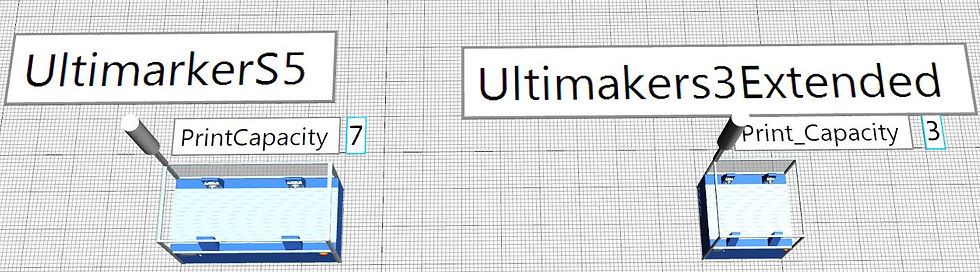
Next, I ran two simulations where i paired the replicated Ultimaker s5 with print capacity 7 and the Ultimaker 3 extended with 3 prints in the first simulation, and for the second simulation the Ultimaker s5 with 6 print capacity and the Ultimaker 3 extended with 4 print capacity.
In the first simulation, i made use of 10 Ultimaker s5 printers with 7 print capacity each and 5 Ultimaker 3 extended printers with 3 capacity each. with this, I was easily able to simulate the 30,000 phone casing by using the ratio of 7:3 to know the amount of product expected from the printer with 7 print capacity and that for the 3 print capacity. By ratio, the 10 Ultimaker s5 printers were supposed to generate 21,000 phone case parts and the 5 Ultimaker 3 extended were to generate 9,000.
assigning the Ultimaker s5 stations a processing time of 11hours 20 mins and the Ultimaker 3 extended stations 8 hours 5 minutes, the simulation resulted to 202 days 2 hours.


I ran a similar process in the second simulation but this time with 10 Ultimaker s5 with 6 print capacity and 5 Ultimaker 3 extended with 4 print capacity and setting their processing times at 9 hours 43 minutes for the Ultimaker s5 and 10 hours 52 minutes for the Ultimaker 3 extended, the simulation resulted to a mass printing process of 271 days 16 hours with the Ultimaker s5's producing 18,000 prints and the Ultimaker 3 extended's producing 12,000 prints.


With the first simulation running for 202 days and 2 hours taking priority because of its lesser amount of days, I needed to account for times when the station is not available for production and the times to repair it. Tecnomatix being the go-to software for plant simulation has this feature as well. Is it not just Awesome! Setting the availability of the all processing station to 95% and putting the Mean time to repair at 1 minute (MTTR) I ran my chosen simulation again this time I set it to stop at 202 days and 2 hours just like it simulated before it was only able to produce 29,541 phone case prints a total difference of 459 prints remaining. I never expected it would be that much for printing stations with 95% availability and 1 minute. with the aim being 30,000 prints, I went on to simulate the possible time to get the required number of prints. I must say that this next process was not as easy as the rest because it kept running till infinity when I try to let it simulate on its own thereby resulting in me literary inputting times where I felt the simulation would generate 30,000 prints, I must have simulated this more than 15 times before I could pinpoint the time to the second. with the current availability time and MTTR, I was able to identify that it would take 212 days 21 hours 19minutes and 55 seconds to generate up to 30,000 prints.


to cement the simulation, I needed to identify positions where periods of long waiting time i.e "Bottlenecks" can be seen in the production process. again going to the ever-useful plant simulation software, Tecnomatix I was able to utilize its "Bottleneck analyzer" tool in looking for bottlenecks in the production process. Aside from the 95% availability of machines which resulted in 5% failure as can be seen in red, the overall working periods for the printers which can be seen in green is sufficient and their wait time as depicted in ash color shows the time when they had finished their process and was ready for another job. the yellow portion as seen in "PLAandPVA1" and "PLAandPVA2" shows the time the sources had to wait to give out PLA and PVA materials for printing. I would say that this can be neglected for now as the source can be likened to a store full of PLA and PVA materials needed for the project and is always ready to be dispatched and used on the printers.




Result: rounding up the 212 days 21 hours 19 minutes and 55 seconds to the nearest day, i had 213 days to generate 30,000 prints actually this means that for 213 days x 24 hours, 5112 hours princity will have to be working nonstop.
Based on my approach do you think I will be able to fit in all the processes needed for Phone-R-Us to be able to produce 30,000 phones within one year (256 working days)?


Comments